
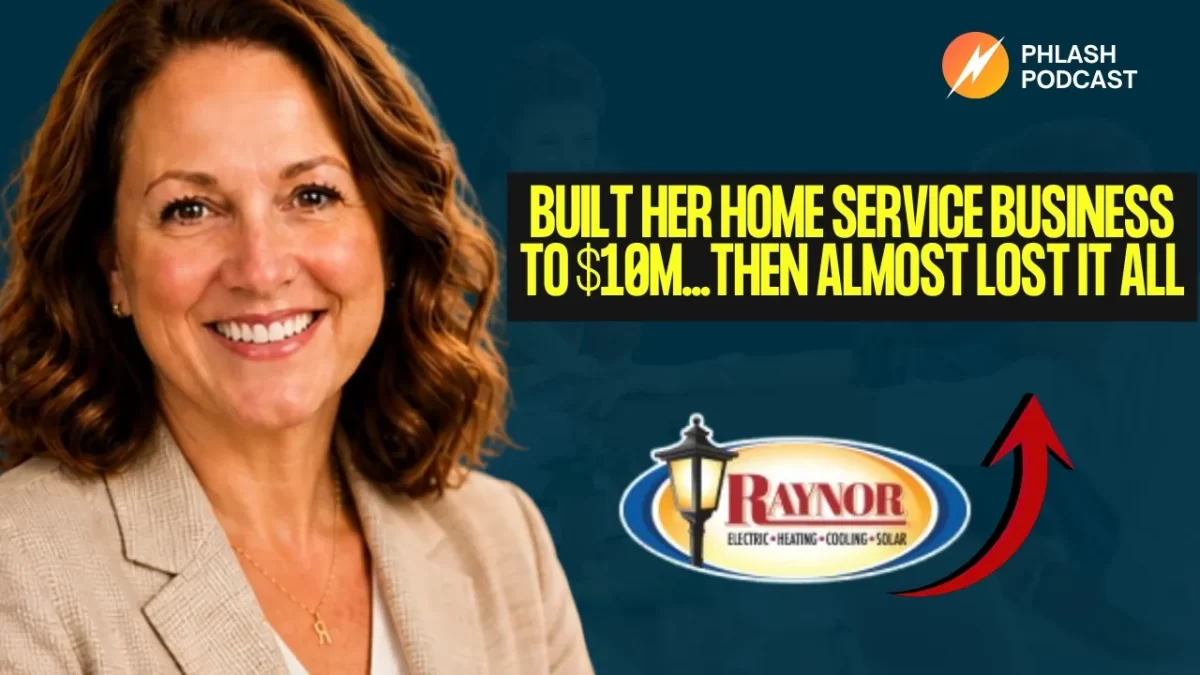
Built Her Home Service Business to $10M…Then Almost Lost it all

Built Her Home Service Business to $10M…Then Almost Lost it all
Most people think scaling a home service business is about running more ads.
It’s not.
You can spend $50,000 a month on marketing and still stay stuck if your operations are chaotic, your team doesn’t trust the company, and your customer experience breaks the moment growth happens.
Kerri Raynor learned that the hard way.
She and her husband built Raynor Services from a small electrical company into a $10 million home service business before eventually selling the company to a private equity-backed group. But the path wasn’t clean, glamorous, or linear.
It involved:
- A housing market crash
- Failed implementations
- Wiring a generator wrong and frying a customer’s house
- A class action lawsuit
- Endless operational mistakes
- And one massive realization:
Growth without systems creates chaos.
What follows is the real story behind how they scaled. Not the polished version. The operational version.
The version most contractors actually need to hear.
From Oncology Nurse to Home Service Operator
Kerri never planned to run a home service company.
She was an oncology nurse working with cancer patients when she married her husband, a master electrician who had started Raynor Services.
He was the visionary.
She became the integrator.
“I brought processes, procedures, and implementation,” she explained. “My husband was the visionary. I was the implementer.”
That combination became the foundation of the company’s growth.
But early on, growth was slow.
Like many trades businesses, they were stuck doing high-volume, low-margin work for general contractors.
The company survived.
But it wasn’t scaling.
The Unlock That Changed Everything
The first major turning point came in 2009 when they joined Nexstar, a best practices organization for home service businesses.
At the time, they were doing around $600,000 in revenue.
Kerri described it as hitting a wall.
“You can get so far on common knowledge. But eventually you hit a wall.”
Nexstar exposed them to systems they had never seen before:
- Call scripts
- Membership models
- Better invoicing
- Dispatch systems
- Customer experience standards
- Peer networking with other contractors
More importantly, it exposed them to operators who were ahead of them.
That changed everything.
“We realized we didn’t know what we didn’t know.”
Ironically, revenue initially dipped after implementing these changes because they slowed down long enough to rebuild properly.
But after that, growth accelerated fast.
Even during the housing market crash.
Why Networking Became Their Biggest Competitive Advantage
One of the strongest themes throughout Kerri’s story is that relationships drove almost every breakthrough.
Not ads.
Not hacks.
Relationships.
Networking gave them access to:
- Better systems
- Better ideas
- Better vendors
- Better operators
- Better leadership models
Someone handed Kerri an invoice template at an event and she said it felt revolutionary.
That sounds small.
But operators know small process improvements compound massively over time.
“People paid it forward to me,” she said. “So I always want to pay it forward to others.”
That mindset became part of the company’s DNA.
The Risky Move That Changed Their Business Model
At one point, Raynor Services made a massive strategic decision.
They fired all their general contractors.
Completely.
At the time, most of their work came from builders and contractors.
The problem?
Low margins.
Slow payments.
Heavy admin work.
Kerri described it perfectly:
“Chasing your money was quadruple the work compared to serving homeowners directly.”
So they pivoted entirely toward direct-to-consumer residential service work.
That shift unlocked:
- Higher margins
- Better customer relationships
- Recurring revenue opportunities
- Brand equity
- Membership programs
- Cross-selling opportunities
It also forced them to become operationally elite.
How They Grew Beyond Electrical
Electrical work alone made scaling difficult.
Unlike HVAC, electrical has fewer recurring service opportunities.
“Electric is very set it and forget it,” Kerri explained.
Homeowners don’t naturally buy memberships for electrical inspections.
So they expanded.
First into:
- Solar
- Generators
Then eventually into HVAC.
That was the real accelerator.
“Solar and generators got us to around $3 million,” Kerri said. “HVAC is what really took us to the next level.”
By the time they sold the company, revenue was roughly split 50/50 between electrical and HVAC.
That created enormous cross-selling opportunities.
An HVAC customer could become an electrical customer.
An electrical customer could become a generator customer.
Now customer lifetime value exploded.
The Real Secret to Growth Wasn’t Marketing
Kerri was blunt about marketing.
“You can’t afford every vendor promising they’ll make you millions.”
Instead, they focused on grassroots systems.
One example completely transformed their online reputation.
A review company told Kerri they needed more reviews to improve SEO.
She couldn’t afford the service.
So she built her own system.
After every successful job:
- The office made a happy call
- Customers were told a review email was coming
- The email included direct review links
- The team incentivized reviews internally
The result?
Their reviews more than doubled.
No expensive software.
No fancy automation.
Just process discipline.
Why Negative Reviews Helped Them Grow
One of the most surprising parts of Kerri’s story was how they handled negative reviews.
She personally responded to every single one.
Not defensively.
Not aggressively.
With accountability.
“We’re human. We make mistakes. How can we make it right?”
Customers started calling specifically because of those responses.
“You responded like a real person,” one customer told her. “I knew if something went wrong, you’d fix it.”
That level of transparency became a trust signal.
Most contractors still get this wrong.
The Power of Happy Calls
Kerri and Phil both emphasized one overlooked growth lever:
Happy calls.
Most companies think happy calls are just for customer service.
They’re not.
They’re operational gold.
Happy calls can:
- Catch service issues early
- Generate reviews
- Increase memberships
- Create cross-sell opportunities
- Strengthen retention
- Build loyalty
And most companies barely use them.
The Key to Cross-Selling Without Losing Integrity
One of the hardest parts of scaling a service business is teaching technicians to generate opportunities without turning them into pushy salespeople.
Kerri’s approach was simple:
Technicians must believe the company genuinely takes care of customers.
Otherwise they won’t sell confidently.
You cannot expect technicians to sell what they don’t feel good about.
To reinforce this:
- Departments built relationships together
- Teams attended meetings together
- Technicians received referral spiffs
- Bonuses rewarded opportunity creation, not pressure tactics
Most importantly:
The company culture centered around integrity.
That matters more than scripts.
The Lawsuit That Changed Everything
Then came the moment that changed their entire future.
A former employee filed a wage-and-hour lawsuit.
Kerri discovered they had unknowingly violated overtime laws.
The issue?
Employee bonuses legally needed to be recalculated into overtime rates.
They had no idea.
The lawsuit became a class action case going back six years.
What made it worse:
- Their insurance policy didn’t include the proper wage-and-hour rider
- The legal exposure exceeded half a million dollars
At that moment, Kerri and her husband realized something painful:
They had become the bottleneck.
“Our team deserved more growth than we could provide.”
That realization led them to sell the business.
Selling the Company
Eventually they partnered with The Flint Group.
Kerri was highly intentional about who they sold to.
“We were not selling our souls to the devil just to maximize money.”
They interviewed buyers extensively.
The Flint Group stood out because they focused on:
- Preserving legacy
- Retaining staff
- Keeping the call center intact
- Supporting continued growth
- Allowing founders to stay involved
The partnership worked.
Since the acquisition, the company has reportedly grown more than 200%.
The Most Important Lesson
At the end of the interview, one thing became crystal clear:
The company didn’t scale because they were perfect.
They scaled because they stayed humble enough to learn.
Kerri repeatedly came back to three principles:
- Integrity
- Relationships
- Continuous improvement
That’s what allowed them to survive mistakes, grow through operational walls, and ultimately build something valuable enough to sell.
Not shortcuts.
Not hype.
Not “growth hacks.”
Just disciplined leadership over decades.
And in today’s home service world, that might be the biggest competitive advantage left.