
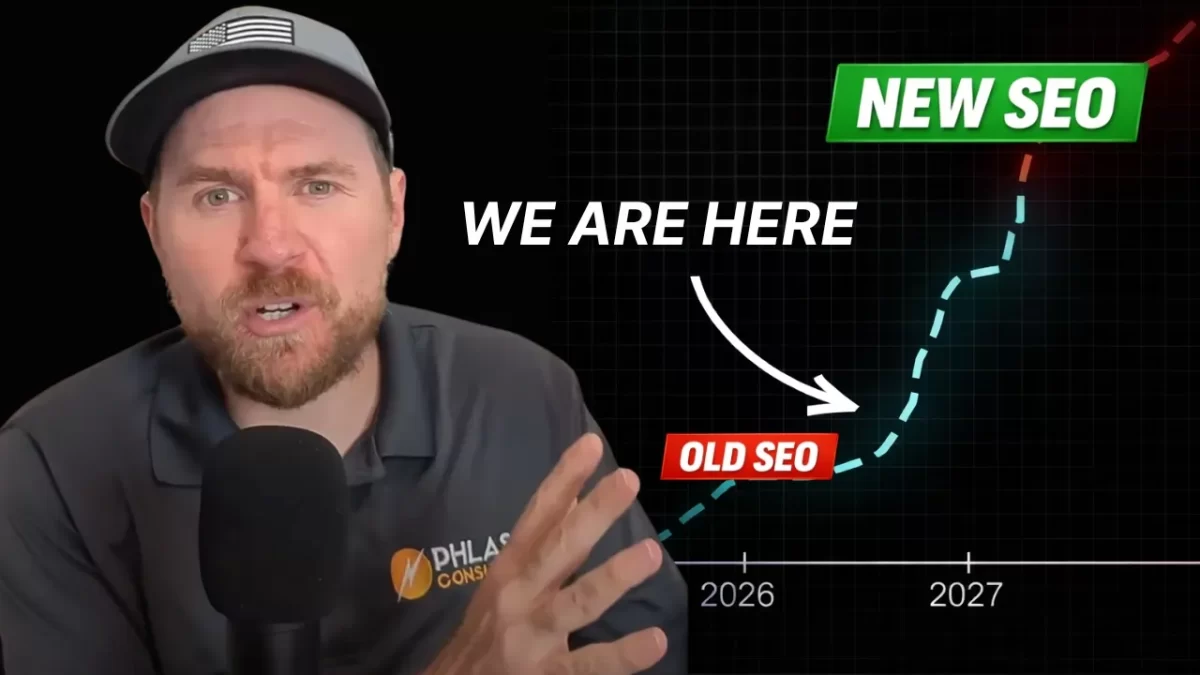
The 5 Local SEO Shifts That Will Decide Who Gets Customers by 2028

The 5 Local SEO Shifts That Will Decide Who Gets Customers by 2028
If you run a home service business, the way you get customers from Google is changing fast.
Most businesses are not ready for it.
This is not a small update or a new tactic to layer on top of what you are already doing. This is a fundamental shift. The kind of shift we have not seen since the move from Yellow Pages to Google.
Now we are moving from Google to AI-driven search.
Over the next few years, this transition will redefine how customers find, evaluate, and choose local businesses. And if you understand what is happening early, there is a massive opportunity to get ahead while others fall behind.
Here are the five major shifts happening right now and how to position your business to win.
Shift 1: From Keywords to Conversations
For years, local SEO has been built around keywords.
People would search things like:
- HVAC repair near me
- Gutter cleaning near me
- Plumber in Dallas
Businesses optimized their websites to rank for these phrases.
That model is breaking.
Today, people are searching differently. Instead of typing short phrases, they are asking full questions:
- How much does it cost to repair an HVAC system?
- Do I need to replace my water heater or repair it?
- How often should I clean my gutters?
Search is becoming conversational.
This matters because longer, question-based searches are far more likely to trigger AI-generated answers instead of traditional search results. The more detailed the query, the more likely the user never even sees a list of websites.
Instead, they get a direct answer.
This means your job is no longer just to rank for keywords. Your job is to become part of the conversation.
Shift 2: From SEO Pages to Trust Signals
Traditional SEO focused heavily on producing pages.
Service pages. City pages. Blog posts targeting long-tail keywords.
That still works, but it is no longer enough.
AI systems do not just rank pages. They evaluate trust.
They look for signals that your business is credible, experienced, and relevant. And they build that trust based on the content they can find about you across the internet.
Here is where most businesses go wrong.
They generate generic AI content that sounds like everyone else.
If every company is publishing the same recycled answers, none of them stand out.
The businesses that will win are the ones producing real content.
Content based on actual customer conversations. Real questions. Real answers. Real expertise.
One of the most effective ways to do this is simple:
Turn your customer calls into content.
Your call recordings, sales conversations, and service discussions are filled with the exact questions your customers are asking. That is the raw material AI systems are looking for.
When you turn those into blog posts, videos, and resources, you are not just marketing your business. You are training AI to trust it.
Shift 3: From Rankings to Recommendations
For the past two decades, SEO has been about rankings.
Where do you show up on Google?
Are you number one? Number three? Page two?
That mindset is becoming outdated.
AI is changing the decision-making process.
Instead of showing users a list of options, AI is starting to recommend specific businesses based on the user’s needs, preferences, and context.
This is a major shift.
Users are no longer comparing ten websites. They are being guided toward one or two recommendations.
That means the goal is no longer just visibility.
The goal is trust.
You want AI systems to confidently say:
“This is the business you should use.”
And that only happens when you have strong, consistent trust signals across your content, your website, and your online presence.
Shift 4: From Clicks to Agent-Driven Booking
The traditional conversion path looks like this:
Search → Click → Website → Form submission
That path is starting to disappear.
AI is moving toward handling the entire process.
A user might ask:
“Find me a gutter cleaning company near me and book an appointment.”
Instead of sending the user to a website, the AI can:
- Find a business
- Check pricing
- View availability
- Recommend a time
- Book the appointment
All without the user ever visiting your site.
This is what is known as agent-driven booking.
And it is already starting to happen.
To prepare for this, your business needs to be structured differently.
You need:
- Clear pricing information
- Online booking capabilities
- Estimate calculators
- Structured, accessible data
If your only conversion method is a contact form, you are going to lose business in this new environment.
Shift 5: From SEO Agencies to Content Systems
Most SEO services today are built on repeatable tasks.
Keyword research. Page creation. Backlinks. Monthly reports.
That model is becoming commoditized.
Much of it can already be automated.
As a result, it is becoming less effective and more competitive, driving a race to the bottom.
The future is not about buying SEO packages.
It is about building a content system inside your business.
A system that:
- Captures real customer questions
- Turns them into high-quality content
- Distributes that content across multiple channels
- Continuously feeds AI systems with relevant, trustworthy information
This is not a one-time effort.
It is an ongoing engine.
And the businesses that build this engine will dominate local search in the AI era.
The New Playbook for Local SEO
The old model looked like this:
- Keywords
- SEO pages
- Rankings
- Clicks
- Generic SEO services
The new model looks like this:
- Conversations
- Trust signals
- Recommendations
- Agent-driven interactions
- Content systems
This is not a small evolution. It is a complete rewrite.
What You Should Do Next
If your current strategy is still focused entirely on rankings and traffic, you are operating on a fading playbook.
That does not mean you should abandon SEO overnight. But it does mean you need to start adapting now.
Start by asking:
- Are we creating content based on real customer conversations?
- Do we have strong trust signals across our online presence?
- Can customers book or get pricing without friction?
- Are we building a system or just executing tasks?
The businesses that answer these questions early will capture the next wave of local search.
The ones that do not will slowly lose visibility, leads, and relevance.
The shift is already happening.
The only question is whether you are positioning yourself to benefit from it or be left behind.