
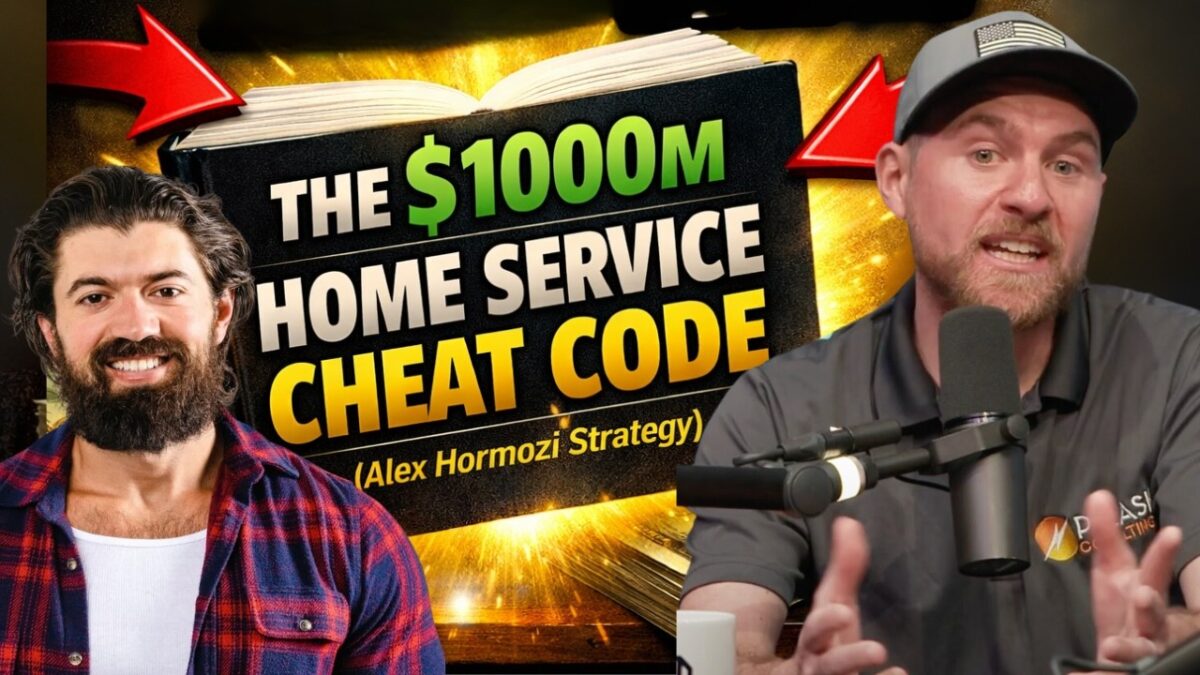
The $100M Home Service Cheat Code (Alex Hormozi Strategy)

The $100M Home Service Cheat Code (Alex Hormozi Strategy)
If you run a home service business, you do not have a demand problem.
You have a leverage problem.
Homeowners wake up with issues. Leaky roofs. Broken furnaces. Outdated bathrooms. Overflowing gutters. They are not looking for clever marketing. They are looking for relief.
The question is this:
How do you position your business as the obvious choice, increase revenue per customer, and build predictable growth without guessing?
That is what this breakdown is about.
In this guide I am going to walk you through how to apply the frameworks from $100M Offers, $100M Leads, and $100M Money Models directly to your home service business.
No fluff. No theory. Just practical application.
Part 1: $100M Offers and the Value Equation
At the core of $100M Offers is one simple formula:
Value =
Dream Outcome × Perceived Likelihood of Achievement
Divided by
Time Delay × Effort and Sacrifice
Most home service businesses focus only on the top half.
They talk about what they do.
Very few focus on the bottom half.
That is where the leverage lives.
1. Dream Outcome
Customers do not actually want gutter cleaning.
They want water to stop pouring over the side of their house.
They do not want a bathroom remodel.
They want a space they enjoy walking into every morning.
Your job is to uncover the real outcome.
In home services, customers often diagnose the symptom. Your team has to uncover the deeper outcome inside the sales process.
That is the difference between quoting a job and building value.
2. Perceived Likelihood of Achievement
People do not need to believe the outcome is possible.
They need to believe you can deliver it.
This is built in two places:
First, digitally
Second, inside your conversion process
Digitally, this means:
- Real before and after photos
- Reviews front and center
- Clear process explanation
- Authority positioning
- Guarantees
Inside your sales process, this means:
- Confident tone
- Clear explanation
- Relevant examples
- Logical next steps
Home service businesses make two decisions happen:
- The decision to call you
- The decision to hire you
Both must reinforce credibility.
3. Time Delay and Effort
This is the overlooked goldmine.
The faster someone gets relief, the more valuable your offer becomes.
The less effort required from them, the more valuable your offer becomes.
From a digital perspective, this means:
- Online scheduling
- Instant estimate tools
- Transparent pricing guides
- Sticky headers on mobile with click-to-call
- Simple forms
If someone has to fill out a contact form and wait two days for a callback, value drops immediately.
If they can see pricing guidance and book now, value increases instantly.
Inside the business, this means:
- Same-day or next-day scheduling for members
- Cleanup guarantees
- Not requiring homeowners to be present
- Proactive scheduling
- Communication portals with photo updates
Affluent homeowners care deeply about time and convenience.
If you reduce friction, you increase perceived value.
Part 2: The Grand Slam Membership Framework
Everyone wants memberships.
Most businesses present them poorly.
Here is the mistake:
They sell features instead of outcomes.
Instead of saying:
Annual inspection, priority scheduling, member pricing
Frame it like this
Dream Outcome:
Never worry about surprise breakdowns again.
Likelihood:
If we miss something and it fails, we fix it.
Time Delay:
Members get same-day or next-day priority scheduling.
Effort:
You never have to remember to call. We schedule everything.
That is a Grand Slam offer.
The script framework looks like this:
- Let the customer explain their problem
- Reframe their real outcome
- Establish authority calmly
- Present two options
- Introduce the proactive version
- Stack value
- Reduce effort
- Close with choice
Example:
One option is we clean the gutters and solve today’s issue.
The other option is we put you on a proactive schedule so you never deal with this again.
No pressure.
Just contrast.
When framed correctly, memberships stop feeling like an upsell and start feeling logical.
Part 3: $100M Leads and Capturing Demand
In home services, you are not creating demand.
You are capturing it.
There are four core ways to get customers:
- Post free content
- Run paid ads
- Warm outreach
- Cold outreach
1. Free Content
For home services, this means Google dominance.
Three areas matter:
- On-site SEO (service pages and service area pages)
- Off-site SEO (Google Business Profile reviews and proximity)
- AI overview content (answering real customer questions)
If customers ask, “How much does HVAC repair cost?”
You should have that content.
Listen to call recordings.
Turn real questions into blog posts.
Do not spam content.
Focus on better and more useful content.
2. Paid Ads
Google LSA and search ads should typically be first.
But here is the real point:
You must know your numbers.
Cost per lead.
Customer acquisition cost.
Lifetime value.
Return on ad spend.
You cannot scale what you do not measure.
3. Warm Outreach
This is massively underused.
B2B partnerships can generate serious revenue.
HVAC companies referring duct cleaning.
Interior designers referring remodelers.
Roofers referring siding contractors.
You likely already get referrals.
You probably do not have a system to generate more.
Warm outreach also includes:
- Email marketing your past customers
- Text campaigns
- Calling your database proactively
You cannot get lifetime value without a lifetime relationship.
4. Cold Outreach
Door knocking.
Cold calling.
List calling.
It works, especially in higher-ticket categories like roofing.
It is manual but viable.
Part 4: $100M Money Models and Revenue Leverage
Most home service businesses focus only on lead generation.
The bigger opportunity is monetization.
There are four revenue levers:
- Attraction offers
- Upsells
- Downsells
- Continuity
Attraction Offers
Examples:
- HVAC giveaway
- Free inspection
- Buy three cleanings, get one free
- Pay less now or pay more later
Giveaways can dramatically lower cost per lead while generating volume.
Shoulder season becomes easier when you run strategic attraction offers.
Upsells
You likely already use:
- Good, better, best packages
- Add-on upgrades
- Anchoring
The underused one is the rollover upsell.
Example:
Customer pays $250 per year for maintenance.
After three years, you credit $750 toward a new system.
It feels like value.
It functions like a promotion.
Downsells
If someone hesitates, give them:
- Payment plans
- Reduced feature versions
- Trial offers
Capture something instead of losing everything.
Continuity
This is the game changer.
Bonuses for signing up.
Discounts for committing.
Waived fees for long-term agreements.
Continuity is best presented at the point of problem.
When someone calls with an issue, that is when they are most open to proactive protection.
If you layer:
- Attraction offers at the front
- Continuity during scheduling
- Upsells during sales
- Downsells when needed
Your revenue per lead increases automatically.
What Should You Focus on First?
If you are under $1M:
You likely have a lead generation problem.
Focus on demand capture first.
If you are over $1M:
You likely have a leverage problem.
You rely on one or two lead sources.
You do not have layered money models.
You do not fully optimize value.
Once you scale past $1M, running more ads stops being the solution.
You need systems.
The Real Opportunity
Home service businesses are uniquely positioned.
You do not have to manufacture desire.
You solve urgent problems.
If you:
- Increase perceived value
- Reduce time delay
- Reduce effort
- Capture demand across multiple channels
- Layer attraction, upsell, downsell, and continuity models
There is no reason you cannot scale predictably.
The frameworks are not complicated.
The execution just needs to be intentional.
And when you stop guessing and start building systems, growth becomes repeatable.