
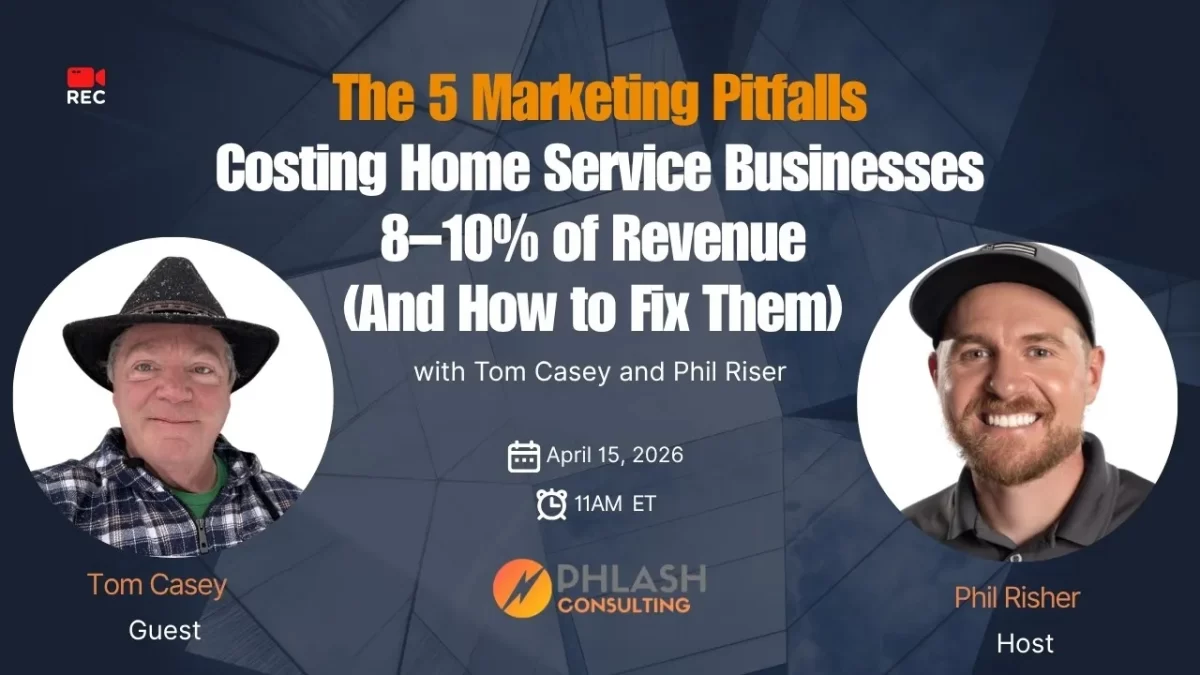
5 Marketing Pitfalls Costing Home Service Businesses 8 to 10% of Their Revenue & How to Fix Them

5 Marketing Pitfalls Costing Home Service Businesses 8 to 10% of Their Revenue & How to Fix Them
Most home service companies do not have a lead problem.
They have a marketing strategy problem.
That was the core message from a recent conversation between Tom Casey and Phil Risher. Tom brings a rare perspective to the table: he is a third-generation tradesman, a founder who has built and exited multiple home service businesses, and someone who speaks from operating experience, not theory.
His point was simple.
Too many contractors are spending real money, their money, without a clear understanding of why the results feel inconsistent, disappointing, or impossible to scale.
According to Tom, there are five common marketing pitfalls that quietly drain 8 to 10% of revenue for home service businesses. The good news is that each one can be fixed.
Here is what they are and what to do instead.
1. Ignoring the Trigger That Makes People Buy
The first mistake is misunderstanding what actually causes a customer to call.
Tom broke this into two types of triggers:
Internal triggers are wants.
Think pizza. People already want it. You do not need to convince them to desire it.
External triggers are events.
Think plumbing leaks, broken AC systems, noisy garage doors, pests, stains on siding, or dead grass. These are not things homeowners wake up hoping to buy. Something goes wrong, and that problem triggers the purchase.
That distinction matters more than most contractors realize.
A lot of home service marketing is built around discounts, promotions, and offers meant to “create demand.” But in many categories, demand is not created by the offer. It is created by the problem.
Nobody wakes up excited to buy a new water heater.
Nobody circles the date on the calendar to replace their electrical panel.
Nobody gets emotionally inspired by a coupon for a new AC system they do not need yet.
That is why so many discount-heavy campaigns fall flat. A $2 pizza coupon gets saved. A $1,500-off HVAC postcard gets thrown away. The pizza is wanted. The HVAC system is not.
The fix
Stop trying to persuade people to want something they fundamentally do not want.
Instead, build your marketing around the real trigger behind the purchase.
If someone says they need a new toilet, the real question is not “great, what model do you want?” The real question is “why now?”
Is it leaking? Cracked? Backing up? Causing damage?
The better you understand the trigger, the better you can align your messaging with what the customer is actually experiencing in that moment.
That is what moves people to act.
2. Putting Media Before Message
The second mistake is focusing on where to market before getting clear on what to say.
This shows up everywhere:
- “We need to be on Facebook.”
- “We should try direct mail.”
- “Radio does not work.”
- “Google Ads are too expensive.”
- “Billboards did nothing.”
Tom’s view was blunt and accurate: the platform is often not the problem. The message is.
If your message is generic, overly technical, cluttered, or forgettable, it will fail almost anywhere. A bad mailer will not suddenly work because you switch to Meta. A weak radio ad will not become effective just because you buy more spots.
Media cannot rescue bad messaging.
One of the most common examples is when businesses try to say too much at once. They list every service they offer, every feature they have, every technical detail they think matters, and every promotion they can fit on the page.
The result is confusion.
And a confused mind usually says no.
The fix
Simplify.
A strong message gives the customer one clear thought to latch onto.
Instead of talking about everything, focus on one compelling idea that reflects what the customer actually cares about.
Tom shared a great example from a garage door company. After studying the market, they discovered that one of the biggest homeowner concerns was not aesthetics or smart technology. It was noise. People hated noisy garage doors, and many were afraid the door was unsafe because it sounded so bad.
That insight shaped the message.
Once you know the message that resonates, you can carry it across every channel:
- direct mail
- radio
- billboards
- Meta ads
- social media
- your website
Phil added another smart layer to this: build your marketing around a content calendar so every channel reinforces the same central message. When one month is about spring AC inspections, everything should support that theme. When another month is about indoor air quality, every touchpoint should speak to it.
Consistency makes the message stronger.
3. Choosing Tactics Over Strategy
This is where many home service businesses get stuck in a cycle that feels productive but is actually unstable.
They chase leads.
Then chase more leads.
Then spend more to replace the leads they used to get cheaper.
Tom described the problem as relying too heavily on short-term sales activation and ignoring long-term brand building.
Those are two different functions of marketing.
Short-term marketing is built to generate action now.
This includes things like tune-up offers, paid search, local service ads, and limited-time promotions.
Long-term marketing is built to make your business known, liked, and trusted.
This includes brand messaging, SEO, AEO, consistent content, reputation, direct mail frequency, and other efforts that help you become the company people think of first when something breaks.
Both matter.
But most contractors overinvest in short-term tactics because they need leads immediately. The problem is that short-term tactics often become less effective over time. Offers fatigue. Audiences tune them out. Cost per lead rises. Then the answer becomes “spend more.”
That is not strategy. That is dependency.
Tom compared it to hunting versus farming.
Hunting gets food today.
Farming creates a system that feeds you over and over again.
A healthy business does both.
The fix
Split your marketing budget between short-term sales activation and long-term brand building.
There is no universal ratio that works for every market or trade. Anyone claiming there is should be viewed carefully. Your budget mix depends on your market, your goals, your competition, your margins, and your current brand strength.
But the bigger principle is this:
Do not build a business that can only survive if you keep feeding paid channels.
Invest in assets that compound.
That includes:
- strong local SEO
- better content
- better reviews
- clear positioning
- stronger brand signals
- customer email nurture
- community partnerships
- neighborhood authority
Phil made another important point here. Many agencies naturally push the channels that make them money. If they sell ads, the solution is often more ads. If they sell websites, the solution becomes a new website.
That does not always mean bad intent. But it does mean the contractor has to think strategically, not just tactically.
4. Prioritizing Reach Over Frequency
A lot of companies believe more reach is always better.
Tom disagrees.
He would rather reach 2,000 right people ten times than 10,000 people twice.
That is because frequency creates familiarity, and familiarity drives trust.
In home services, people usually are not memorizing contractor names in advance. They remember you because they have seen you repeatedly. Then, when the trigger happens, they recognize your name when they search, ask in a neighborhood group, or compare providers.
This is where frequency pays off.
A homeowner may still Google “plumber near me.”
But when your name appears in that list, they are far more likely to choose you if they have seen your trucks, your mailers, your reviews, your social posts, or your ads before.
That recognition is the win.
It is not always about bypassing search. It is often about winning once search begins.
The fix
Go deep before you go wide.
Instead of spreading your budget thin across a huge area, dominate smaller pockets with repeated exposure.
That could mean:
- mailing the same neighborhood consistently
- targeting specific service-area pages for SEO
- running local campaigns around the same message
- reinforcing direct mail with social ads in the same ZIP code
- using yard signs and local partnerships to build visibility
- building content around neighborhood-specific needs
Tom gave a strong example from radio. Rather than buying a few spots on the biggest station, he found success by dominating smaller stations with more frequency. The audience was smaller, but the repetition made the brand memorable.
The same logic applies to direct mail, social media, SEO, and email.
One touch rarely changes anything.
Repeated exposure does.
5. Underfunding the Outcome You Want
The last pitfall sounds counterintuitive, but it is real: many businesses simply do not spend enough to achieve the growth they want.
Tom described marketing budget as fuel.
If you are trying to fly from New York to Los Angeles but only put in enough fuel to reach Montana, you are landing in Montana.
That is how many home service companies treat marketing. They want aggressive growth with maintenance-level spending. Then they are surprised when the business stalls.
Tom’s general benchmark was that many contractors need around 8 to 10% of revenue invested in marketing for moderate growth. Some can maintain with less. Some entering new markets or competing in crowded territories may need significantly more.
A newer brand in a competitive market will often need a much heavier lift than an established company with strong reviews, local trust, and years of visibility.
The fix
Match your budget to your actual goal.
If you want modest growth, your spend can reflect that.
If you want to launch a new market, take share from bigger players, or build awareness fast, you need to budget for that reality.
What matters is not blindly spending more. It is spending enough, in the right places, with the right strategy, to give the business a fair chance to win.
Phil and Tom both pointed out that smaller players often win by being more agile, more local, and more scrappy than large competitors.
That can include:
- building referral partnerships
- using email more effectively
- creating better content
- dominating Google Business Profile
- optimizing review responses
- publishing neighborhood-specific pages
- reinforcing local trust signals everywhere
Big competitors often outspend smaller companies. But they do not always out-execute them locally.
How to Measure Whether Your Marketing Is Actually Working
This part of the conversation was especially useful because both Tom and Phil pushed back on overcomplicating attribution.
Tom’s view was that many businesses get lost chasing perfect ROI tracking when they should start higher up.
He focuses first on two questions:
- Did we stay within budget?
- Did we get the number of leads we needed?
From there, he looks at the bigger operating picture.
Phil shared a broader set of metrics that gives a clearer year-over-year view:
- leads
- job count
- estimates created
- close rate
- revenue
- new customers
That is the smarter starting point for most businesses.
Because if leads are up but revenue is not, that might not be a marketing problem. It could be operations, sales, pricing, or lead quality.
The lesson here is simple: do not get buried in vanity metrics or channel arguments. Start with business outcomes, then work backward.
A Smarter Way to Own a Neighborhood
One of the most practical takeaways from the conversation was how to think about segmentation.
Most companies segment based on the homeowner.
Tom argues that you should often segment based on the house.
That means looking at:
- age of home
- value of home
- style and type of home
- service history patterns
- neighborhood characteristics
- likely replacement timelines
That is often more predictive than trying to build a profile around age, education, or family structure.
A house needs what a house needs.
If you know which types of homes tend to produce the best jobs for your business, you can find more neighborhoods full of those homes and target them repeatedly.
Then layer your strategy:
- monthly client mailers
- monthly prospect mailers
- social media targeting in the same area
- localized website pages
- review content from that neighborhood
- local referral partnerships
- local proof and testimonials
That is how you build real neighborhood dominance.
Final Take
The biggest insight from this conversation is that wasted marketing spend usually is not caused by a single bad channel.
It is caused by bad alignment.
Bad alignment between the trigger and the message.
Bad alignment between the message and the medium.
Bad alignment between tactics and strategy.
Bad alignment between reach and frequency.
Bad alignment between growth goals and budget.
When those things are off, marketing feels random.
When they are aligned, it starts to compound.
And for home service businesses, that is the real game.
Not just generating a lead today.
But becoming the company people think of first tomorrow.