
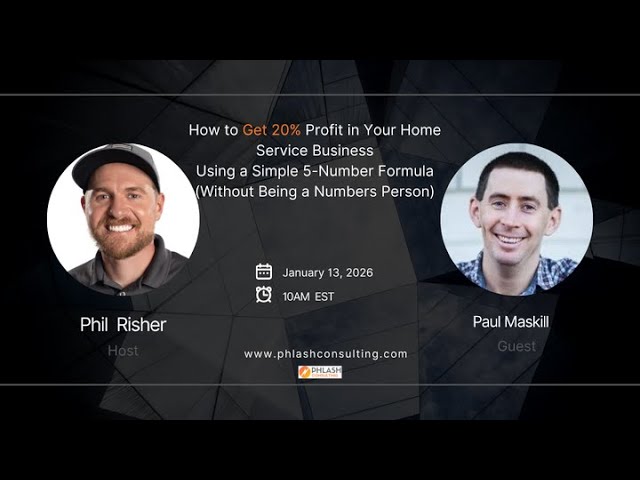
How to get 20% profit in your home service business

How to get 20% profit in your home service business
If you own a home service business, you likely didn’t start it because you love spreadsheets or accounting. You probably started it because you had a skill, a trade, or a craft that you were great at. Before you knew it, you had a real business, but now you’re trying to figure out where all the money goes, why your P&L shows a profit but your bank account doesn’t, and how to get to a consistent 20% net profit.
That’s where this simple five-number formula comes in.
Why Most Home Service Businesses Struggle With Profit
Most tradespeople didn’t go to business school. They got into business to serve customers, deliver excellent work, and build something of their own. But somewhere along the way, they found themselves running payroll, answering phones, and trying to decipher QuickBooks reports that seem to say they made money, even though there’s no cash in the bank.
Paul’s own story started the same way: his dad was a one-man hardwood flooring business who urged him not to go into the trades. Paul got a finance degree, worked in corporate, and eventually realized corporate jobs weren’t secure either. He jumped into entrepreneurship, built and sold four businesses, and learned the hard way how to use numbers to scale and sell.
Why Your P&L Shows Profit But You’re Still Broke
There are a lot of reasons why your profit doesn’t match your bank balance:
- Owner’s draws don’t show up on your P&L.
- Vehicle payments (specifically the principal) only show on your balance sheet.
- Accounts receivable might be showing revenue you haven’t collected.
Bottom line: If you’re not tracking cash flow, your financial statements are just numbers on a page. That’s why Paul recommends working with three professionals:
- A bookkeeper who understands the trades
- A CPA for taxes
- A fractional CFO who can help you make decisions
The Five Drivers of Profit
To build consistent 20% net profit, Paul teaches clients to focus on five key areas:
1. Cost of Goods Sold (COGS)
This includes all the costs required to deliver your service:
- Field labor (including payroll taxes, benefits, and workers comp)
- Materials and supplies
- Permits, equipment rentals, and subcontractors
Target: COGS should be 40-50% of revenue.
2. Gross Profit
Revenue minus COGS. This is the money you have left to run the business.
Target: Gross profit should be 50-60%.
3. Marketing Spend
Covers advertising, branding, and customer acquisition.
Target: 8-12%, though strong brands may be closer to 3-4%.
4. Office Payroll
Everyone who doesn’t deliver the service: CSRs, dispatch, admin, etc.
Target: 10-12% of revenue.
5. Overhead
Everything else: rent, software, utilities, insurance, etc.
Target: 10-15%, ideally lower as you scale.
Profit Formula in Action
Want 20% net profit? Here’s the math:
- 50% COGS
- 10% Marketing
- 10% Office Payroll
- 10% Overhead
- = 20% Net Profit
Of course, every industry has nuances. Construction-heavy businesses may have lower gross profit but less overhead. Service-heavy businesses need more dispatch and office staff. But the formula works.
Why Scaling Won’t Save You
Paul sees it all the time: companies doing $4M, $5M, even $7M in revenue with less than 3% net profit. Owners tell themselves, If we can just hit $10M, everything will be fine.
Wrong.
If you’re not profitable at $3M, you won’t be at $10M. You’ll just have more trucks, more payroll, more problems.
Want proof? In a review of 70 home service companies, the average revenue was $4M. The average net profit? 3.3%.
Avoid the Buy a Truck to Save on Taxes Trap
One of the most common mistakes? Buying trucks at the end of the year to lower your tax bill. It’s a trap.
Yes, you get accelerated depreciation. But you’re financing a $1,700/month vehicle for 60+ months to save $20,000 in taxes. It destroys your cash flow. And if you sell the vehicle early, you may have to “pay back” some of the depreciation.
Unless the truck produces revenue, it’s a liability. Don’t let tax advice kill your business.
So What Should You Do?
- Start with your P&L.
- Move field labor to COGS.
- Group expenses into Paul’s five buckets.
- Track these numbers monthly.
- Don’t just look at cash in the bank.
- Build a simple scoreboard: Revenue, COGS, Gross Profit, Marketing, Office Payroll, Overhead.
- Compare year-over-year.
- Growth needs to be intentional, not aspirational.
- Incentivize your team.
- Give project managers and technicians scorecards.
- Align bonuses with gross profit and job costing.
- Forecast, don’t just budget.
- A budget is a hope. A forecast is a plan.
- Revisit and revise monthly.
Final Thought: Profit is a Habit
Whether you’re doing $500K or $5M, the same principles apply. Master the five numbers, build your scoreboard, and start making decisions with your data, not your emotions.