
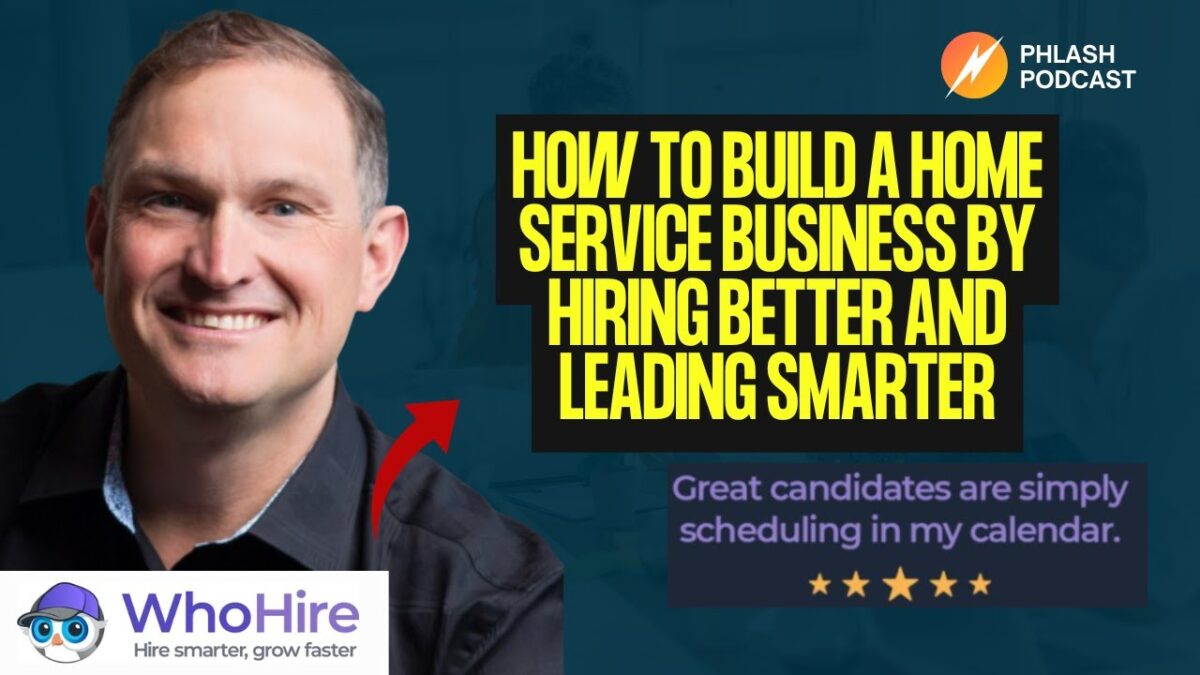
How to Build a Home Service Business by Hiring Better and Leading Smarter with Jonathan Whistman

How to Build a Home Service Business by Hiring Better and Leading Smarter with Jonathan Whistman
Running a home service business isn’t just about fixing HVAC systems, installing plumbing, or repairing roofs. It’s about building a team, one that’s skilled, loyal, and motivated to perform at the highest level.
In a recent conversation, I sat down with Jonathan Wisman, CEO and founder of Who Hire, an AI-powered talent intelligence platform built for trades and service businesses. Jonathan is also the author of The Sales Boss and has helped countless companies reduce technician turnover by more than half, while doubling their per-person revenue.
His mission? To help leaders in the trades build high-performing, people-first organizations that scale with confidence and consistency.
The People Problem Every Business Owner Faces
Jonathan’s journey started after building and selling multiple companies. He says his grandfather once told him:
“Business would be easy if it weren’t for the people.”
He quickly realized how true that was. When you hire and lead well, business feels effortless, like everything just works. But when you get the “people part” wrong, every day becomes a grind.
That’s what inspired him to write The Sales Boss and later create Who Hire, a platform designed to help business owners find, attract, and retain the right humans for the job.
Why AI Is Changing the Way Trades Hire
The trades industry, HVAC, plumbing, electrical, solar, roofing — has traditionally relied on gut instinct for hiring. But Jonathan argues that intuition isn’t a strategy.
“If gut instinct worked,” he says, “we wouldn’t have a 50% divorce rate.”
Who Hire uses data-driven assessments to predict which applicants will perform best and stay the longest. Built on advanced algorithms and behavioral science, the platform helps companies understand which traits actually lead to success in specific roles.
By partnering with organizations like NextStar, Who Hire has gathered rich psychographic and performance data from thousands of employees. The result is a model that lets business owners know — before hiring, who’s most likely to excel, stay loyal, and grow with the company.
The Cost of a Bad Hire
Jonathan doesn’t sugarcoat the reality: a single bad hire can cost a business upwards of $500,000 when you factor in training, lost productivity, and turnover.
Most home service companies still make these high-stakes decisions based on gut feel or the judgment of an inexperienced recruiter, often someone who’s never done the job they’re hiring for.
“They’re trusting the future of their company to someone scanning résumés,” Jonathan says. “It’s almost laughable when you think about it.”
Who Hire replaces that guesswork with insights backed by data, helping companies make smarter, faster, and more confident hiring decisions.
The Group Interview: A Stage Play for Culture Fit
One of Jonathan’s most fascinating concepts is the group interview as a “stage play put on by a psychologist.”
It’s not a traditional roundtable interview. It’s a structured experience where every element — from lighting and music to staff roles, is intentionally designed to observe behavior.
Different team members play roles: one as the leader, one as the skeptic, one as the introvert, and even an undercover applicant who interacts with candidates outside the room.
This process reveals who people really are — not just how they perform in a formal interview.
“When you make a hiring decision,” Jonathan says, “you’re writing a half-million-dollar check. You should treat it that way.”
Think, Feel, Act: Redefining Onboarding
Hiring great people is only half the battle. Onboarding determines whether they stay.
Jonathan teaches a concept called Think, Feel, Act — a method for designing onboarding experiences with intention.
He encourages leaders to walk through their facilities and ask:
- What do I want new hires to think about this company?
- What do I want them to feel on day one?
- How do I want them to act moving forward?
Every detail — from the lobby to the bathrooms to the breakroom — should reinforce the message that your company builds champions.
“You’re sending someone into your community with your family name on their shirt,” he says. “Are you sure you’ve done everything you can to equip them for success?”
The Future of Leadership in the Trades
Great companies don’t find great people by accident. They build systems that attract them.
If your hiring process still relies on gut instinct and guesswork, you’re already behind. The trades are evolving, and the companies that invest in data, leadership, and human development will be the ones that win.
Because in the end, as Jonathan puts it:
“People don’t want to work less — they just don’t want to work for you if you don’t inspire them.”