
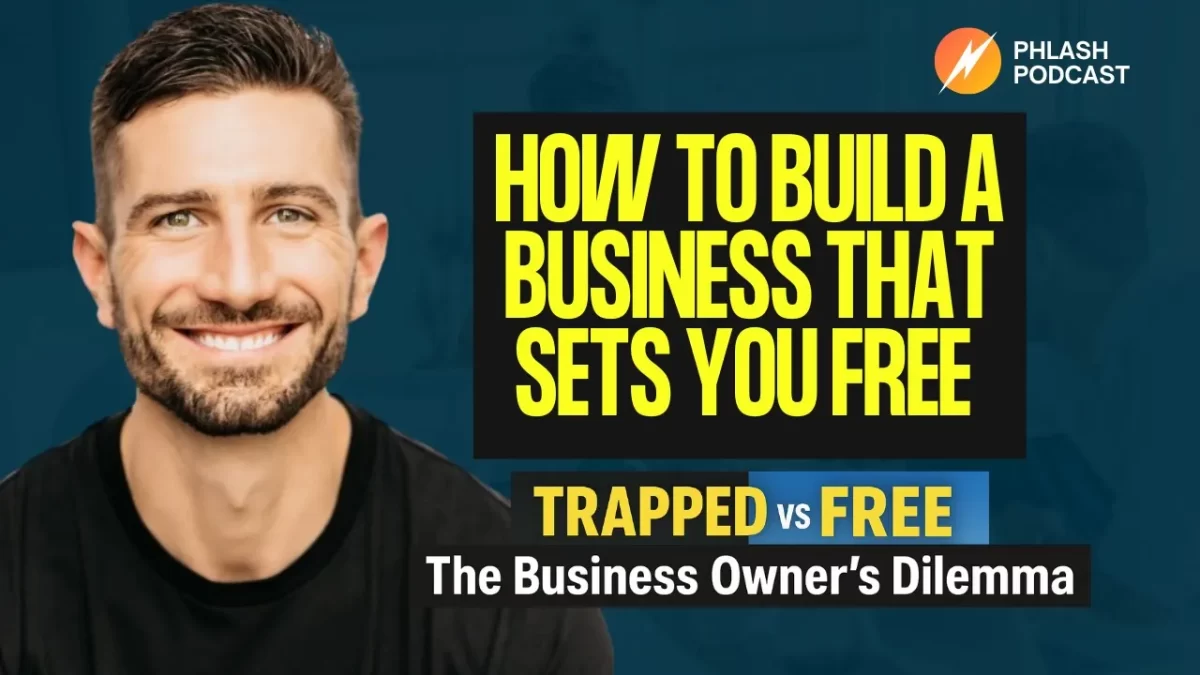
How to Build a Business that Sets you free Instead of Trapping you with Ryan Tansom

How to Build a Business that Sets you free Instead of Trapping you with Ryan Tansom
Most entrepreneurs start a business to gain freedom more time, more money, and more control. Yet many wake up years later feeling like prisoners to the very company they built.
That’s the trap Ryan Tansom knows all too well. After helping turn around his family’s $21M copier business, selling it for eight figures, and then facing the realities of taxes, layoffs, and burnout, he realized that financial success doesn’t always equal freedom.
Today, as the founder of Independence by Design and host of a 400+ episode podcast, Ryan helps business owners design companies that work for them not the other way around. He’s guided over 1,500 entrepreneurs through a playbook that creates what he calls owner-optional businesses.
Here are some of his biggest lessons:
The Owner-Operator Trap
Most small to mid sized businesses solve for revenue, gross profit, or net income without asking a bigger question: What’s the point?
Ryan calls this the owner operator trap. In it, entrepreneurs:
- Make gut-based decisions instead of following a framework
- Have unpredictable cash flow
- Stay stuck in their own job
The result? A company that pays the bills but chains the owner to daily operations.
Time, Cash Flow, and Wealth: The Real Metrics
Instead of only chasing top line growth, Ryan challenges owners to align business decisions with three personal outcomes:
- Time – Do you have the freedom to do what you want each day?
- Cash Flow – Does the business generate sustainable income?
- Wealth – Are you building equity or assets outside the business?
These three levers create what Ryan calls escape velocity the point where an owner can run the company from the boardroom rather than the job site.
The Owner’s Playbook: Plan → Build → Elevate
Ryan’s framework breaks down into three phases:
- Plan – Clarify your goals around time, cash flow, and wealth. Without this foundation, you’re just guessing.
- Build – Invest in the people, systems, and structure that make the business less dependent on you.
- Elevate – Transition into a capital allocator role, making strategic decisions instead of operational ones.
Each phase comes with reinvestment decisions and trade offs. The key is understanding what those trade-offs mean for your freedom, not just your revenue.
Common Inflection Points for Home Service Businesses
Ryan points out a few revenue “traps” where owners often get stuck:
- $1M–$3M: The owner is still in the weeds doing sales, jobs, or both. Building an operational team becomes crucial.
- $3M–$5M: The owner usually still drives big-ticket sales. Stepping out of this role is necessary for growth.
- $5M–$10M: Compensation structures for the leadership team become the bottleneck. Without them, scaling stalls.
In every phase, the question remains: Do I reinvest for future wealth, or take cash out for lifestyle and security?
Optionality: The Real Goal
For Ryan, freedom isn’t about selling the company or hitting a certain revenue milestone. It’s about optional outcomes.
You might choose to:
- Keep running your business and draw income
- Hire a CEO and run it from the boardroom
- Scale and sell to private equity
- Or simply enjoy a quarter-million-dollar lifestyle working 30 hours a week
The key is knowing what you’re solving for and designing your business accordingly.
Final Takeaway
Ryan sums it up with a phrase he borrowed from Andrew Huberman:
“I’m not going to tell you what to do. Just know what you’re doing.”
Most entrepreneurs fall into the trap of working harder without asking whether it’s actually moving them closer to the life they want.
If you’re building a home service business between $1M and $10M, now is the time to step back, clarify your goals, and decide whether your company is working for you or you’re still working for it.
Because in the end, real success isn’t just about revenue. It’s about freedom.