
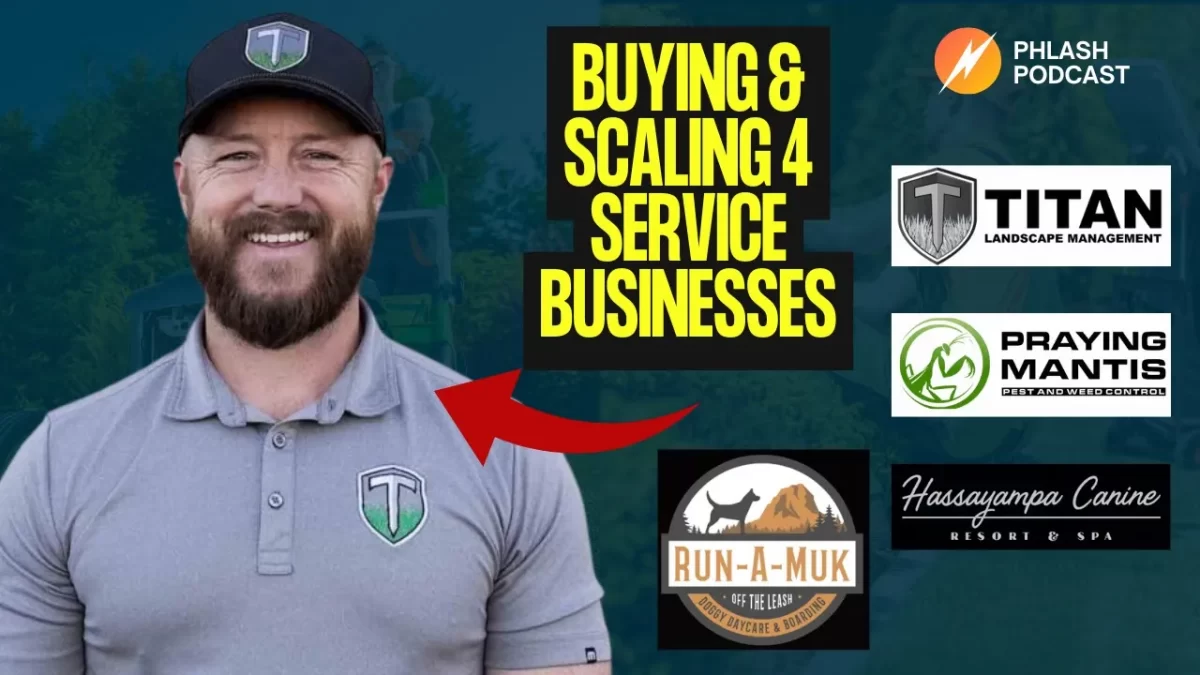
Buying & Scaling 4 Service Businesses with Keith Sklarsky

Buying & Scaling 4 Service Businesses with Keith Sklarsky
Most business owners dream of growth, but few consider acquisition as a viable path. Keith Scarski changed that perspective when he transitioned from 10 years in corporate sales management to building a multi-business empire in Prescott, Arizona. His journey offers a blueprint for entrepreneurs looking to scale beyond their current operations.
The Catalyst: When Corporate Life Meets Opportunity
Scarski’s story began with a geographic move that didn’t align with his employer’s plans. Facing inevitable termination, he spotted an opportunity that would reshape his career trajectory: a dog hotel and daycare business for sale in his new hometown.
“That was kind of my first realization of the way that people operate a lot of these businesses,” Scarski explains. “You don’t have to start these things, but you could come in and bring a skill set and improve on a business that somebody’s already started.”
This insight became the foundation of his acquisition strategy: identify underperforming businesses with solid fundamentals and apply systematic improvements.
The Acquisition Approach: Three Distinct Strategies
Strategy 1: Traditional Listings
For his first acquisition, Scarski used SBA financing to purchase the dog hotel through a business for sale listing. This approach offers the advantage of working with sellers who have already decided to exit.
Strategy 2: Cold Outreach with Data
His second acquisition came through strategic cold calling. After analyzing market data owner age, business size, years in operation he identified potential sellers who might be ready to retire but hadn’t yet listed their businesses.
“When you can look at that and see that there’s opportunity there, you can have a pretty good idea that if the current owner wanted to do something like that, they would have already done it,” he notes.
Strategy 3: Broker Relationships
The third and fourth businesses came through a local business broker who recognized the synergy between Scarski’s goals and available opportunities. This relationship led to acquiring both a commercial landscape company and a pest control operation in a single transaction.
The Integration Framework: People First, Systems Second
One of Scarski’s key insights involves the human element of acquisitions. Rather than bringing in outside management immediately, he focuses on elevating existing employees.
“We try to buy businesses that have existing employees that are promising because it’s hard to purchase a new business. The team’s already going through the owner leaving and you coming in, and then bringing in an outside hire just adds another layer of uncertainty.”
His integration process follows a clear sequence:
- Understand before changing: Fully comprehend what the previous owner was doing and why
- Identify internal talent: Look for employees showing promise and leadership potential
- Delegate systematically: Transfer responsibilities gradually while providing support
- Invest in growth: Provide opportunities for advancement and increased earning potential
The Technology and Systems Revolution
Many mom and pop operations run on outdated systems sometimes decades behind industry standards. Scarski encountered a pest control business using a DOS-based system with handwritten notes.
The systematic upgrade included:
- Modern software platforms that track chemicals, time, and customer communications
- Automated customer notifications for service appointments
- Digital documentation with photo capabilities and customer notes
- Billing integration that creates transparency and trust
“Communication at the front end fixes” most customer retention issues, Scarski emphasizes. “If a customer knows when you’re going to be here, if they know that you’ve done the job, if they trust it, and then you send them a bill, they’re not going to think twice about that.”
The Pricing Psychology Breakthrough
A common barrier for service businesses is pricing fear the belief that customers will leave if prices increase. Scarski’s experience suggests otherwise.
“If the price is the only thing that’s keeping your customers, there’s something broken somewhere else,” he argues. “Once you fix that, customers are more than willing to pay because they don’t want the hassle of changing over when they love what you do.”
His approach to price increases focuses on:
- Clear communication about the reasons for changes
- Value demonstration through improved service quality
- Customer education about cost pressures and business sustainability
- Relationship building that makes switching costs too high
The Rebranding Decision Matrix
Not every acquisition requires a complete rebrand. Scarski’s decision framework considers:
- Logo and visual identity quality: Does it represent the service level you want to deliver?
- Brand reputation: Are existing reviews and market perception aligned with your goals?
- Employee pride: Will your team feel confident representing this brand?
- Customer expectations: Does the current brand support premium pricing?
For the pest control company, the rebrand was essential. The existing logo appeared outdated, and the review history was predominantly negative. The investment in new branding, truck wraps, and marketing materials created a fresh market entry point.
Performance Systems That Drive Results
Scarski’s operations include performance-based compensation that aligns employee incentives with business growth:
- Customer acquisition bonuses: Technicians earn commissions for bringing in new clients
- Review incentives: Team members receive compensation for generating positive customer feedback
- Route density optimization: As territories grow, efficiency metrics become more relevant
- Upselling training: Customer service representatives develop sales skills to identify additional service opportunities
The Expansion Philosophy: Data-Driven Growth
Rather than random diversification, Scarski’s expansion strategy centers on customer analysis. “We always look at our existing customers. What other businesses are people who are using pest control going to use?”
This approach has revealed natural adjacencies:
- Window cleaning services
- Pressure washing
- Additional property maintenance services
The key insight: existing customers who trust your service delivery are the most likely to try additional offerings.
Key Takeaways for Business Owners
For Single-Business Owners
- Delegation opportunity: You can apply Scarski’s integration approach to your own business
- Systems thinking: Technology and communication improvements often provide the highest ROI
- Pricing confidence: Focus on value delivery rather than price competition
- Employee development: Your team wants growth opportunities provide them