
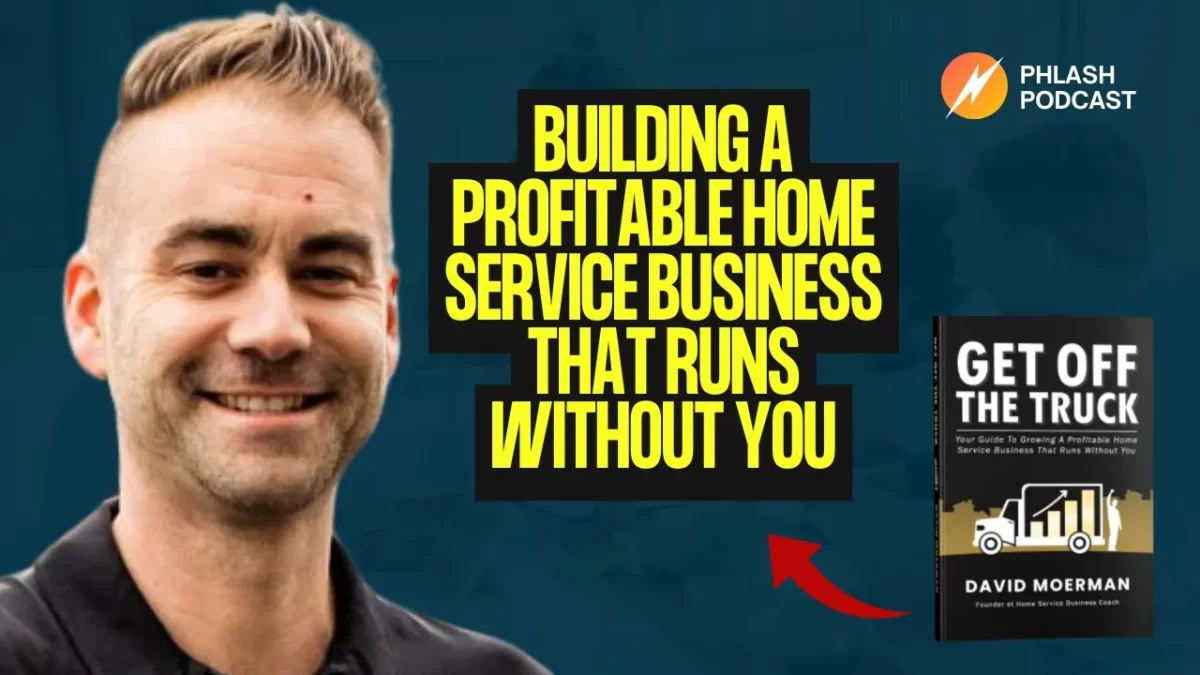
Building a Profitable Home Service Business That Runs Without You with David Moerman

Building a Profitable Home Service Business That Runs Without You with David Moerman
Most home service entrepreneurs start with a simple dream. Make good money, build something meaningful, maybe get off the truck one day. But for many owners, that day never comes. The business grows, but their workload grows even faster. And before long the owner finds themselves trapped in the field, in the office, or on the sales truck with no true freedom.
On a recent episode of the show, I sat down with someone who has escaped that trap and helped hundreds of others do the same. David Moerman is the author of Get Off the Truck and the founder of Home Service Business Coach. He built and sold his own home service company, Revive Services, and has spent the last several years helping other owners build businesses that run without them.
In this conversation, David unpacked practical systems, mindsets, and processes that allow owners to grow profitably, delegate confidently, and escape the daily grind.
Here are the biggest takeaways.
The Path from Stuck to Scalable
David’s home service journey began like many do. Knocking on doors as a college painter. Grinding his way to a six figure first year. Starting a company with three thousand dollars to his name. Then scaling that company for eight years before exiting.
But the turning point was not a single lucky moment. It was systems.
He spent three years writing Get Off the Truck because he saw a consistent pattern. Owners were not failing from lack of hustle. They were failing because their business lived inside their head. They had no playbook. No standard processes. No teachable systems.
His goal with the book was simple. Create a guidebook, not a theory book. Something an owner could pick up, implement, and immediately feel traction.
And one of the biggest areas where owners get stuck is sales.
The Sales Truck Problem
Many companies reach one to five million dollars in revenue while the owner remains the only salesperson. The owner knows the pitch. The owner knows the homeowner. The owner can sell. But nobody else can because nothing is documented.
David lays out an eight step estimate process that turns sales into a teachable system.
- Phone call
- Greeting
- Walkaround
- Measure
- Photos
- Write up
- Presentation
- Follow-up
Simple, repeatable, and transferable.
Most owners have all eight steps in their head, but zero in writing. Which means they cannot duplicate themselves. And that is the real bottleneck.
David emphasizes two things.
First, rapport building is not magic. It is teachable. His team used a cheat sheet of conversation points: pets, gardens, sports teams, recent projects. Anything that allows an estimator to build trust quickly.
Second, fortune is in the follow-up. More than half of his sales closed during follow-up. But owners are terrible at follow-up because they are too busy. A documented process and empowered staff fix that bottleneck instantly.
Empower Your People or Keep Doing It Yourself
One of David’s strongest points was the idea of empowerment. If your salespeople or CSRs do not have the authority to make decisions, they cannot close.
He told a simple story. At a hockey game, he tried to buy his son a foam finger. The employee selling them had no authority to negotiate the price. She could not make a decision. And she lost the sale.
Most home service teams operate the same way.
Give your team permission to solve problems. Give them incentives. Pay commissions. Reward rehash. Celebrate reviews. Build a culture where every employee participates in revenue, not just production.
This alone can take a business from one million to five million.
The CEO Schedule That Actually Works
One of the most common questions owners ask is what to work on once they get off the truck. What does working on the business actually look like?
David’s answer is time blocking.
He has followed a block schedule for nearly twenty years. And it is the reason he was able to run two companies in under forty five hours per week.
Here is how he structured his week.
Monday: operations, team meetings, checking in with crews
Tuesday: estimates
Wednesday: flex and project work
Thursday: estimates
Friday: finance, analytics, planning
The goal is to eliminate switch tasking. No more bouncing between estimates, production, admin, and calls all in one day. That is how owners stay busy without being productive.
He also recommends scheduling only seventy percent of your week. Leave thirty percent open for the inevitable problems that appear.
The second part of this is visibility. David would bring his internal systems and improvements to Monday meetings. He would show his team exactly what he built that week. It built trust and showed the team he was working on things that made their jobs easier and more profitable.
What Should a CEO Actually Work On?
Owners often jump off the truck only to feel lost. David simplifies it with one idea. Work on rainmaker activities. Revenue generating actions that move the company forward.
Do not obsess over font sizes on your website or tiny optimizations. Focus on necessities.
Pull reports from your CRM. Find your highest value neighborhoods. Build a plan to dominate the areas where your best customers already live. Create referral programs. Improve booking rate. Improve close rate. Increase average ticket. Lower customer acquisition cost.
Four numbers drive a nine figure business and they can drive yours too.
Leads booked
Estimates closed
Average ticket
Customer acquisition cost
If you improve those four metrics, growth becomes unavoidable.
The Ten Systems Every Home Service Business Needs
In chapter three of his book, David outlines ten foundational systems. The feedback on this chapter has been overwhelming because it is simple and practical.
A few of the biggest ones.
Inbound call script
Most service businesses take thousands of calls per year. Yet many have no script and no standard way to book jobs. This is the lowest hanging fruit in operations.
Job site checklist
Your crew should follow the same ten step process on every job. Greeting the customer. Parking location. Safety checks. Photos. Pre and post inspections. Upsell opportunities. This prevents callbacks, creates consistency, and gives you a coaching tool instead of chaos.
Pricing sheet
If pricing lives in your head, your team will never sell confidently. David put his pricing publicly on his website and trained his technicians to upsell using a simple price book. This system alone grew his average ticket from three hundred fifty dollars to more than fourteen hundred dollars.
Owners underestimate how much revenue they lose because their team lacks clarity.
You Cannot Win the Race to the Bottom
One of the most powerful ideas in the entire conversation came from David’s service manager Katrina.
We do not aim to be the cheapest. We aim to be the best.
This became a core part of their sales training. And it reframed conversations with customers who were comparing quotes only on price.
In today’s economy customers are price shopping more than ever. And many owners panic. They drop prices. They lower margins. They enter the race to the bottom.
David refused to do that. His booking rate was intentionally around forty five percent. He would lose more bids than he won, but the ones he did win had strong margins and loyal customers.
Pricing is the foundation of the entire business. If you get it wrong, the whole structure falls apart.
The Power of a Great Integrator
A major theme in the episode was the role of key people. David credits much of his company’s growth to finding the right integrator, his service manager Katrina.
She came from Starbucks. She had experience training people. She had run her own business. She had the discipline of someone who had hit goals repeatedly in different industries.
David hired her after a simple phone call that he could not bring himself to end. She joined Revive, rebuilt their systems, managed production, improved routes, strengthened the office, and helped create a company that eventually ran without David.
When he exited the business, he handed the new owners a turnkey company with documented systems and two strong integrators. And that made the business far more valuable.
He sums it up simply.
The ultimate compliment as an entrepreneur is to be the least relevant person in your business.
A Practical Guide for Owners Who Want Freedom
Get Off the Truck is a book built on experience, repetition, and thousands of conversations with stuck contractors. It is not theory. It is not long-winded philosophy. It is a field manual for owners who want a life outside their business.
If you want to grow from owner operator to true CEO, the path is simple.
Document your systems.
Empower your people.
Block your time.
Focus on revenue drivers.
Stop accepting the cheapest customer.
Build a team that makes you irrelevant.
Do these things with consistency and the business will transform.