
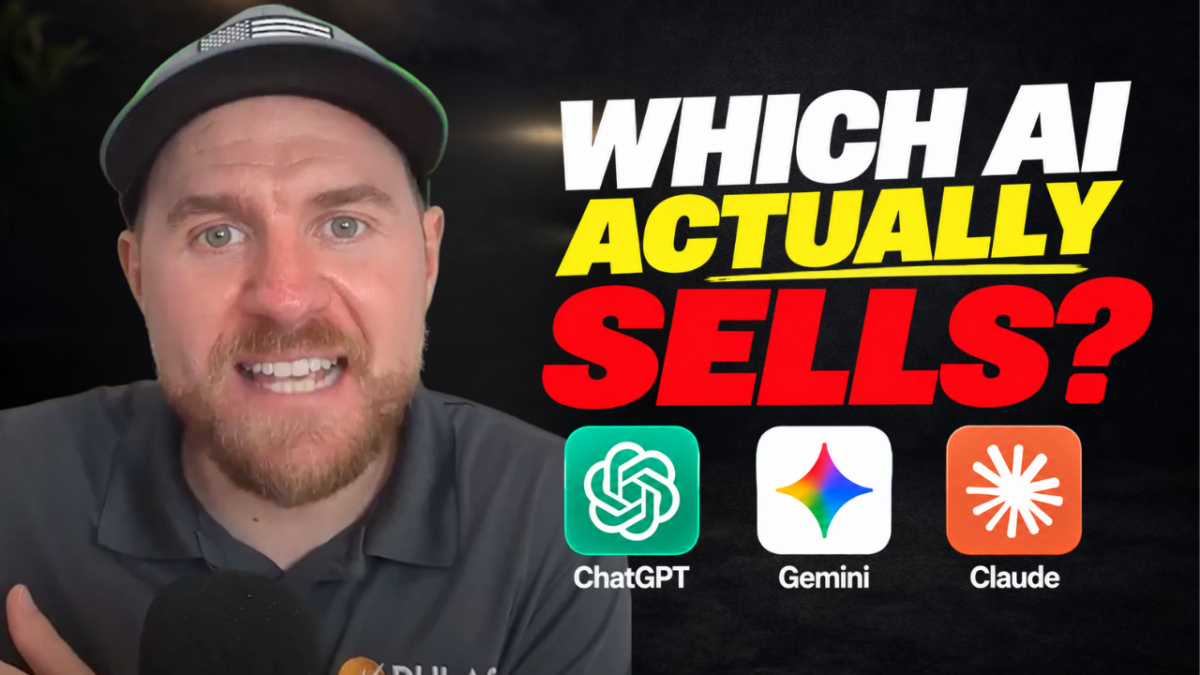
I Tested ChatGPT, Gemini & Claude to See Which Gets More Customers

I Tested ChatGPT, Gemini & Claude to See Which Gets More Customers
If you run a home service business, you’ve probably heard some version of this pitch by now: “You need to show up on ChatGPT.” Or Claude. Or Gemini. Pick your platform, someone’s telling you it’s the future of getting found.
Here’s the problem with that advice: it treats AI search like a popularity contest. Which chatbot has the most buzz? Which one everyone’s talking about on YouTube? That’s the wrong question. The right question is much narrower and much more useful: which platform actually turns a stranger’s search into a booked job for your business?
We put ChatGPT, Gemini, and Claude through five head-to-head rounds to find out, audience size, local data access, buying behavior, a live side-by-side test, and measurability. The results were lopsided, and they point to a strategy that’s a lot more specific than “be everywhere on AI.”
The Five-Round Framework
Round 1: Audience and Adoption
This one’s simple math. Directionally, ChatGPT has the largest individual user base of the three platforms and still leads adoption for AI-assisted local recommendations, a reasonable estimate puts close to half of consumers turning to AI for local search at some point in the past year. Google’s Gemini has been closing the gap quickly, especially since Google restructured its own homepage to push traffic toward AI Mode, which is arguably the biggest change to Google’s core search experience in decades. Claude has grown too, but starts from a much smaller consumer search footprint.
Round winner: ChatGPT. Biggest audience, most attention. But attention isn’t the same as intent, which is where the next four rounds matter more.
Round 2: The Local Search Ecosystem
This round asks a different question: when one of these platforms answers a local search, what data is it actually pulling from?
- ChatGPT primarily draws from web search, forums, citations, and general local listings. It recently struck a partnership to pull in more review and business-portfolio data, which should deepen its local dataset over time.
- Gemini has the deepest bench by far, Google Search, Google Maps, Google Business Profiles, and reviews all feed into one connected ecosystem.
- Claude functions as a capable research tool but doesn’t yet have a dedicated local-discovery layer of its own; in practice, it tends to surface Google Maps and Google Business Profile data rather than an independent local index.
Round winner: Gemini. It has the most complete picture of any individual business, and Google has strong incentive to keep that ecosystem closed off from competitors.
Round 3: Buying Intent and the Customer Journey
Where do people actually start when they need to hire someone? Directionally, the overwhelming majority of local searches still begin on Google, one industry estimate puts it around 80%, with only a small single-digit percentage starting on an AI platform first. Just as telling: a meaningful share of people who do start on an AI platform still go back to Google afterward to cross-check reviews before making a decision. Only a minority say they’d contact a business based on an AI recommendation alone, without further research.
Round winner: Gemini. Not because AI platforms don’t matter, but because Google search, feeding into AI Mode, still sits at the center of the customer journey for the vast majority of buyers.
Round 4: The Live Test
Numbers only tell part of the story, so we ran the same three questions a real customer might ask through all three platforms: Who’s the best HVAC company near me to replace my air conditioner? Can you compare pricing? How do I schedule service?
- ChatGPT returned local names but often no direct contact path, sometimes surfacing a third-party review aggregator instead of the business itself. On pricing, it tended to acknowledge that contractors don’t publish standard rates and gave general ballpark guidance rather than business-specific detail. On scheduling, it did offer clear next steps and suggested talking points.
- Gemini pulled in Google Business Profile data directly, star ratings, price ranges, an embedded map, and links straight to each business. On pricing, it went noticeably deeper, surfacing financing options, rebate programs, and specialty positioning for each contractor. On scheduling, it again pulled Business Profile details, including whether online booking was available.
- Claude pulled from Google Maps data as well, giving a similar experience to Gemini but with less depth, a phone number and a short summary, without the same layer of detail on financing or promotions.
Round winner: Gemini, by a clear margin, on the strength of its pricing detail and complete scheduling path.
Round 5: Can You Actually Measure It?
This might be the most important round for a business owner, because visibility you can’t measure isn’t a strategy, it’s a hope.
Google Search Console now reports on generative AI visibility, impressions for your content specifically within AI Overviews and AI Mode, including blog content and, in some cases, social and video content. As of this writing, this reporting is in beta and rolling out gradually, so not every account has full access yet. Still, it’s the only one of the three platforms that gives business owners a direct visibility metric to track. ChatGPT and Claude referral traffic can be tracked indirectly through UTM parameters, but there’s currently no equivalent way to see whether, or how often your business is actually the answer being surfaced on those platforms.
Round winner: Gemini, by default. You can’t optimize what you can’t see.
Final Scoreboard
| Platform | Where it wins | Where it falls short |
|---|---|---|
| ChatGPT | Largest overall audience and attention | Weak local data depth, harder to measure, more indirect paths to contact |
| Gemini | Deepest local ecosystem, strongest buying-journey position, most detailed live results, only platform with real visibility measurement | Requires investment in Google’s ecosystem (Business Profile, reviews, content) specifically |
| Claude | Strong general research and reasoning tool | Minimal dedicated local-discovery layer, hardest to measure for local search purposes |
The takeaway: ChatGPT may be winning attention. Google is still winning the customer journey. Claude is a genuinely capable tool, but being a great AI product doesn’t automatically make a platform a great customer-acquisition channel for a local business.
A Quick Diagnostic: Where Should You Actually Focus?
Before you spend a single hour on “AI search strategy,” ask yourself these four questions:
- Do I have full access to Google Search Console’s generative AI reporting yet? If not, request or check for it, this is the only current window into your AI visibility.
- Is my Google Business Profile complete and current pricing signals, service categories, financing/promotions, and review volume?
- Does my existing content answer the actual questions in the buying journey not just “top tips” content, but pricing ranges, comparison points, and scheduling logic?
- Am I creating content in more than one format website, video, social, since AI platforms increasingly pull from all of them?
If the honest answer to more than one of these is “no,” that’s your starting point not a new AI platform to chase.
Old Way vs. New Way
| Old Way (Traditional SEO) | New Way (AI Search Era) |
|---|---|
| Optimize for ten blue links on a Google results page | Build a knowledge catalog of content structured to be pulled into AI-generated answers |
| Track keyword rankings and organic traffic | Track mention rate and share of voice, how often and how favorably you show up inside AI answers |
| Generic, broad-appeal content (“7 tips for…”) | Non-commodity content that answers specific buyer questions: pricing ranges, comparisons, diagnostics, scheduling |
| One-size-fits-all channel strategy | Channel-weighted strategy, recognizing that Google’s ecosystem currently carries outsized influence across AI platforms |
| Success measured by clicks | Success measured by AI visibility (where trackable) plus booked jobs |
Action Checklist
- [ ] Check whether your Google Search Console account has generative AI reporting enabled; if not, keep monitoring for rollout
- [ ] Audit your Google Business Profile for completeness pricing signals, service details, financing/promotion callouts, and review volume
- [ ] Identify the 5–10 real questions your customers ask before booking (pricing, comparisons, troubleshooting, scheduling) and build content that directly answers each one
- [ ] Diversify content formats website, video, and social since AI platforms increasingly cite more than just blog text
- [ ] Revisit your channel priorities based on where your actual customers start their search, not which AI platform is trending
- [ ] Build a repeatable process for turning real customer calls and conversations into new content, since that’s the fastest way to build a genuine knowledge catalog
Where This Leaves Home Service Businesses
None of this means ignoring ChatGPT or Claude entirely some customers are there, and some visibility is better than none. But if you’re deciding where to spend limited time and budget, the data points toward a Google-centric strategy first: a complete, review-rich Business Profile, content that answers real buying-journey questions, and consistent tracking through Search Console’s generative AI reporting as it becomes available to you.
The businesses that will do well in this next phase aren’t the ones chasing whichever AI platform is generating the most hype. They’re the ones building a real knowledge catalog, content that any AI platform can understand, trust, and recommend, while keeping their share of voice measurable instead of guessed at.